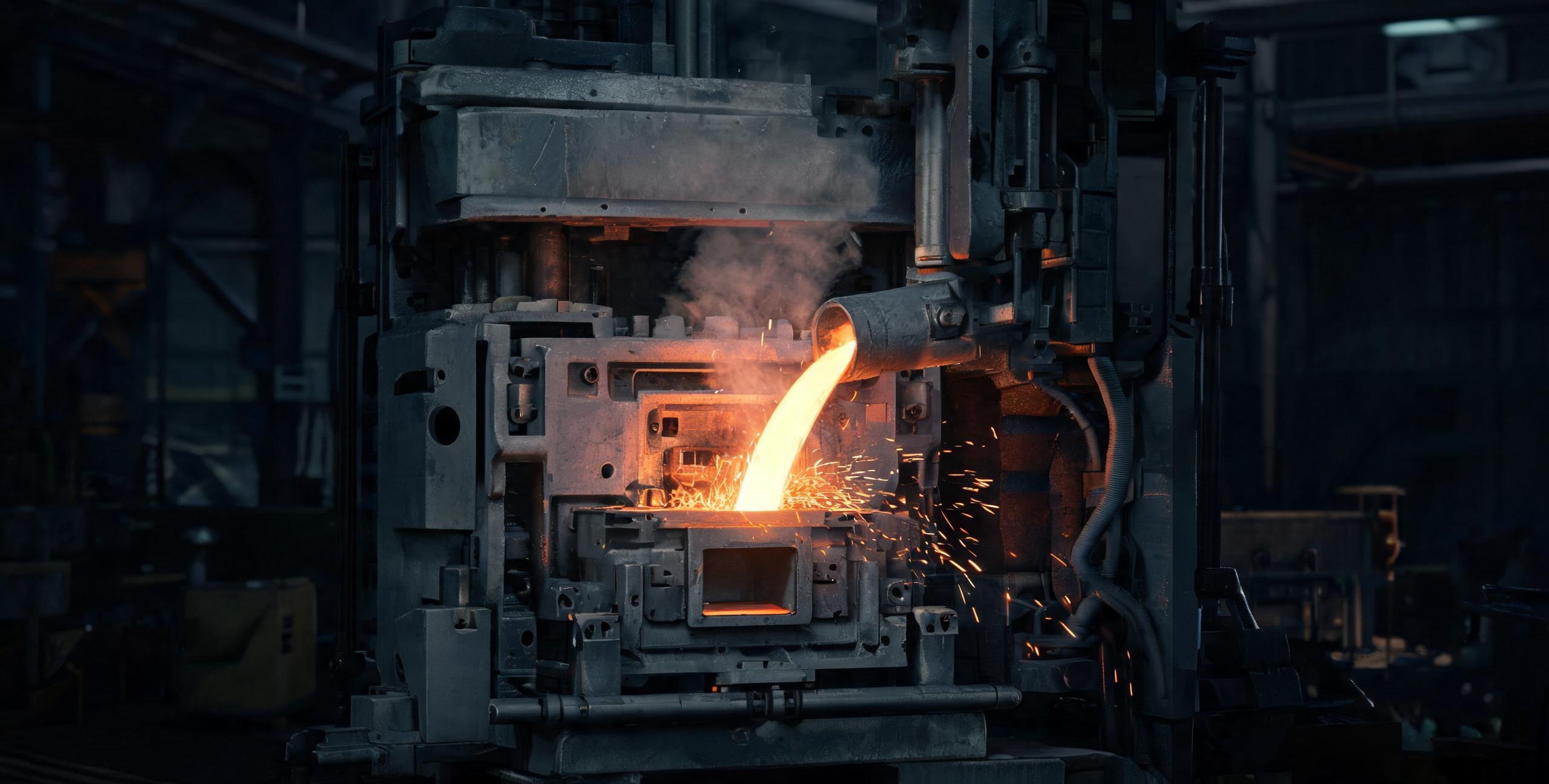
For a 90 g aluminium bracket, a machined billet part might cost USD 14 and a die-cast part USD 2.40 — after a USD 28,000 tool. The crossover volume is rarely where buyers expect it, and the decision is not purely financial: draft angles, wall thickness and porosity limits change what the part can be.
Side-by-side comparison
| Factor | CNC machining | Die casting |
|---|---|---|
| Tooling | None or simple fixtures | USD 20k–60k per die |
| Economic volume | 1–5,000 pcs/year | Above ~5,000 pcs/year |
| Lead time | 7–20 days | 10–16 weeks with tooling |
| Design freedom | Any geometry reachable by tool | Draft angles and uniform walls required |
| Surface finish | Ra 0.8–3.2 directly | Ra 3–6, machined where needed |
Where the break-even really sits
Using the bracket example: at USD 11.60 saving per part, a USD 28,000 die needs roughly 2,400 parts to pay back. But the machined part needs no die maintenance, tolerates design changes and can ship in two weeks. For programmes under 5,000 parts per year, machining is usually the lower-risk choice even when the unit price is higher.
The hybrid route most buyers overlook
For volumes between 2,000 and 10,000 parts, a cast blank with machined interfaces often beats both pure options. The casting delivers the near-net shape cheaply, while machining gives you the bearing bores and sealing faces at ±0.05 mm without a second supplier. Because both steps happen under one roof at TradeMax, the porosity found during machining is corrected before it becomes a shipment problem.
Decision checklist
- Choose machining when annual volume is under 5,000, design is still changing, or tolerances are below ±0.02 mm on many features.
- Choose die casting when the part is stable, thin-walled and the annual volume exceeds 5,000 for at least three years.
- Choose the hybrid route when you need cast economics but machined sealing faces or bearing bores.
- Ask for a should-cost comparison before committing to tooling; it is cheaper than a wrong die.

